

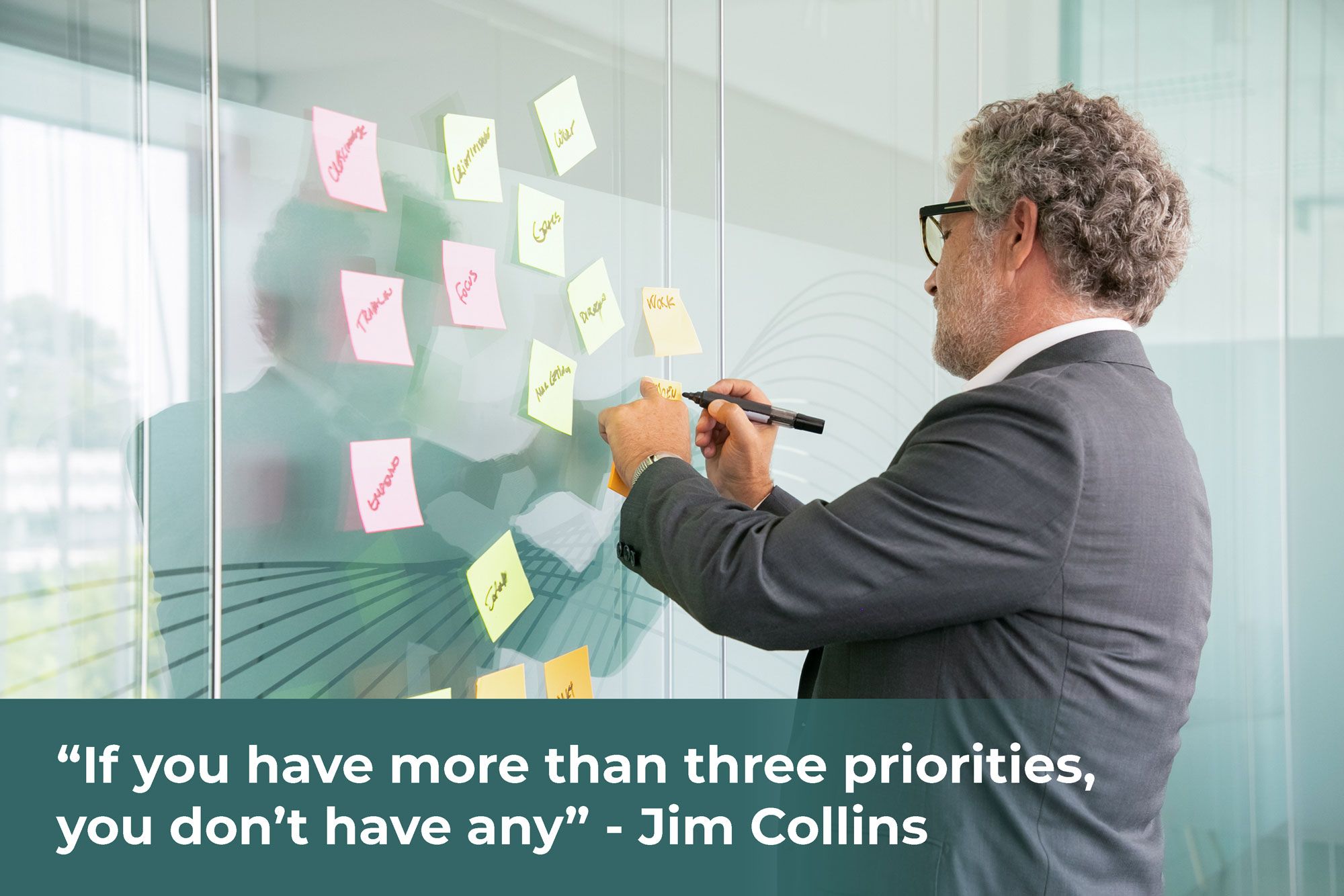
Jim Collins put it bluntly: “If you have more than three priorities, you don’t have any.” I’ve come back to that line dozens of times across corporate roles and early-stage projects. It holds up every time.
The problem with long priority lists is that they create an illusion of progress. You’re busy, the team is busy, the Kanban board is full. But nothing meaningful moves forward. Dispersing attention across too many initiatives is one of the most common ways startups burn through runway before they’ve proven anything.
Why prioritization is harder than it looks
In a large organization, you can afford some slack. Multiple teams, larger budgets, and more forgiving timelines mean you can run several initiatives in parallel and still land somewhere useful. In a startup, that logic breaks down fast. Resources are limited, every week counts, and a wrong bet on what to focus on can be genuinely fatal.
The real difficulty is that everything feels important when you’re building something new. Product, brand, distribution, operations, hiring. The to-do list is never short. The skill is knowing which three things on that list actually determine whether you survive the next quarter.
A real example: launching a medical practice from scratch
When my wife, Dr. Valentina Maitin, was setting up her private practice in Spain, we faced this exact challenge. The list of things we could do was long. Lease a clinic space, buy equipment, build a website, run ads, work on the brand.
We asked one question: what’s the single most important thing to validate right now?
The answer was straightforward. We needed to confirm three assumptions before spending serious money on anything else: do patients actually have the problem we think they have, is our solution the right one for them, and are they willing to pay for it. In other words, we needed to find product-market fit before we committed to fixed costs.
So we rented resources instead of buying them. We ran sales-driven campaigns focused on conversion rate, average revenue per customer, and acquisition cost. We ignored impressions and follower counts entirely. The result was faster learning, lower risk, and a business model we could trust before scaling it.
What this looks like in practice
Prioritization as a discipline comes down to a few consistent behaviors:
- Define the riskiest assumption first. What are you most likely to be wrong about? Start there.
- Separate validation from scaling. Proving something works and building infrastructure around it are two different phases. Don’t run them simultaneously.
- Pick metrics that reflect reality. Vanity metrics feel good but tell you nothing useful. Focus on numbers tied directly to revenue and retention.
- Review your priority list regularly. What was the right focus last month may not be the right focus today.
The corporate version of the same problem
Larger companies deal with a different version of this. The resources are there, but the organizational complexity creates its own kind of noise. If your team’s Kanban board has twenty items marked “in progress,” that’s a signal worth paying attention to. It usually means there’s no real agreement on what matters most, and everyone is hedging by staying active on everything.
The fix is the same in principle: force a ranking, drop what’s at the bottom, and protect the team’s focus on the top two or three items until they’re done or definitively ruled out.
The bottom line
Doing fewer things with more focus produces better outcomes than spreading effort thin across a long list. That’s true in a Series A startup trying to reach profitability and equally true in a regional marketing team managing five markets simultaneously. The constraint changes, but the logic doesn’t.
Start with a short list. Finish things. Then move on.
This post was originally published on LinkedIn.
Comments are closed